Posts

Showing posts with the label HPLC analysis troubleshooting

Oh!! Ghost peaks during HPLC analysis

Image
Though this is funny word 'Ghost' but after all this is also one of the major issue during HPLC analysis. There are many factors which gives rise to such unidentified peaks. Some of important factors are mentioned below: 1) Late eluting peaks: During analysis many times late eluting peaks are found in which they interfere in principle peak in subsequent injections. This can be solved by increasing the run time. 2) Contamination: It sometimes happens that due to some contamination ghost peak used to found during analysis. To handle such situations Ghost buster columns are available in market which can be used. It looks like shown in below image: 3) Water Quality: While preparing mobile phase water quality is not proper then it may give rise to ghost peaks. Such situation should be handled by using either Milli Q grade water or HPLC grade water. 
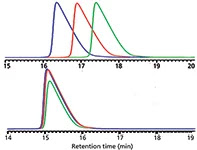
5 causes and solution for changing retention time.

Image
There are many factors impacting Retention time during HPLC analysis. Among them 5 most impacting parameters and there solutions are as below: 1) Contamination build up: This is related to some contaminants which gets retained in the column. This can be solved by continuous flushing using strong solvents. This will flush out the residue and constant retention time will be achieved. 2) Equilibration time: If equilibration time for gradient is not sufficient then it will give variation in retention time. The equilibration time should be sufficient so that constant retention time is achieved. 3) Online degassing: If online degassing is not proper then it will affect the retention time of the peak. Online mobile phase degassing is done by the in build degassed on HPLC system which should be checked from time to time. 4) Evaporation : If reservoir bottles of mobile phase and solvents are not covered properly, slow evaporation of solvent will cause change in mobile phase composition. This ...

3 ways to get rid of %Carryover in HPLC system

 %Carryover in HPLC system is the residue which interferes during routine analysis on HPLC which impacts the actual results. This is one of the most common problem which every analyst encounters during HPLC analysis. Though as a part of system limitations there are certain acceptance criteria for % Carryover i.e. it should not be more than 0.1% of the principle peak, as a common practice. It is very easy to get rid of such %carryover by following three (3) methods: 1) Injection pattern: During analysis injection pattern matters a lot. If high concentration solution is injected first followed by low concentration silution then %carryover is more. So if any high concentration solution is injected it should be followed by blank injection to avoid any %carryover. This is acceptable even by the auditors if more blanks are added. This can also avoid creation of any type of lab events or incidences. 2) Frit cleaning: There is a part called frit after which solution pass into the detector...

5 Major causes of noise in chromatograms during HPLC analysis?

There are 5 major causes for too much noise during HPLC analysis? Noise is the basic problem which every analyst faces during day to day HPLC analysis. Below are the causes which create noise and if properly handled, will definitely solve this problem. 1) Sampling rate: If too much noise is observed then very first check the sampling rate in HPLC method. It should be 1.0 instead of 10 (preferably in case of waters HPLC systems). 2) Pressure graph: Pressure graph to be monitored. If pressure fluctuations are more then it will give rose to noise creations during analysis. 3) Degassing: Degassing of mobile phase. If mobile phase is not degassed properly then it will take time to stabilize the column which will again generate the noise. 4) Detector: If room temperature is fluctuating too much then it will impact on detector which will disturb the baseline and will result in disturbed baseline.  5) Column saturation: Some mobile phase requires some long time to saturate during HPLC a...